
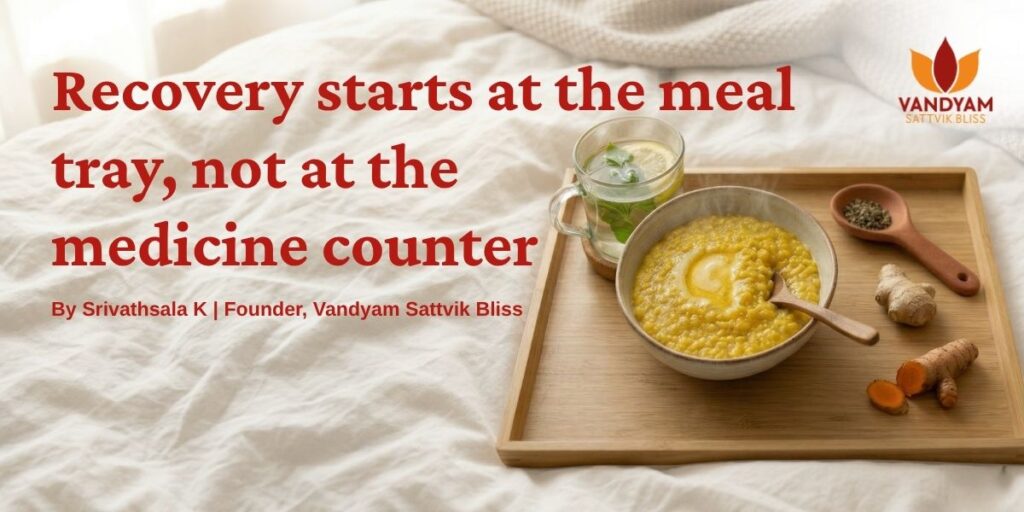
A patient recovers from surgery. The attendant brings the first meal. It is heavy, spiced, sitting in a container that has been waiting for hours. The body — already working harder than it has in months — must now divert energy towards digesting something it was never prepared for.
This is the aspect of hospital care that is seldom talked about. Medicine receives the focus. The meal tray does not.
But our ancient tradition recognised something that modern medicine is only now rediscovering: healing and food are not separate processes. They are one.
WHAT THE VEDIC TRADITION SAYS ABOUT HEALING FOOD
“Pathyam annam aushadham” The right food is itself medicine. — Charaka Samhita |
The Charaka Samhita — the foundational Ayurvedic text — dedicates entire chapters to what a recovering body needs to eat, and how. Not as supplementary guidance. As the primary intervention.
The core principle is Agni — the digestive fire. When the body is healing, Agni is weak. It cannot handle heavy, spiced, stale, or complex food. Forcing it to do so diverts the body’s vital energy away from healing.
WHAT A RECOVERING BODY ACTUALLY NEEDS
1 | Light, easy-to-digest food A weakened Agni can process simple, gently cooked food — soft grains, light dals, steamed vegetables. Heavy oils, sharp spices, and complex combinations ask too much of a system already under strain. The easier the food is to digest, the more energy the body can direct toward repair. |
2 | No onion, no garlic — no Tamas Both onion and garlic are Tamasic — they increase inertia, dullness, and heaviness in the system. A recovering body needs exactly the opposite: calm, lightness, and settled energy. The Sattvik kitchen removes them not as a restriction, but as a gift to the healing process. |
3 | Freshly cooked — prana intact The Chandogya Upanishad tells us the subtlest part of food becomes the mind and the life force within us. A body fighting to recover needs that prana fully intact. Food that has sat for hours arrives without it. The timing of the meal is not a logistical detail. It is a clinical one. |
Medicine heals the disease. Food rebuilds the person. One cannot do the work of both — but both must be present for full recovery to happen. |
This is what Sattvik food signifies in a hospital setting. It is not simply vegetarian food given to a vegetarian patient. It is food crafted, from the very beginning, to support a healing body rather than hinder it. Light enough to avoid burdening. Pure enough to avoid agitation. Fresh enough to embody life force.
The meal tray is not an afterthought; it is therapy.